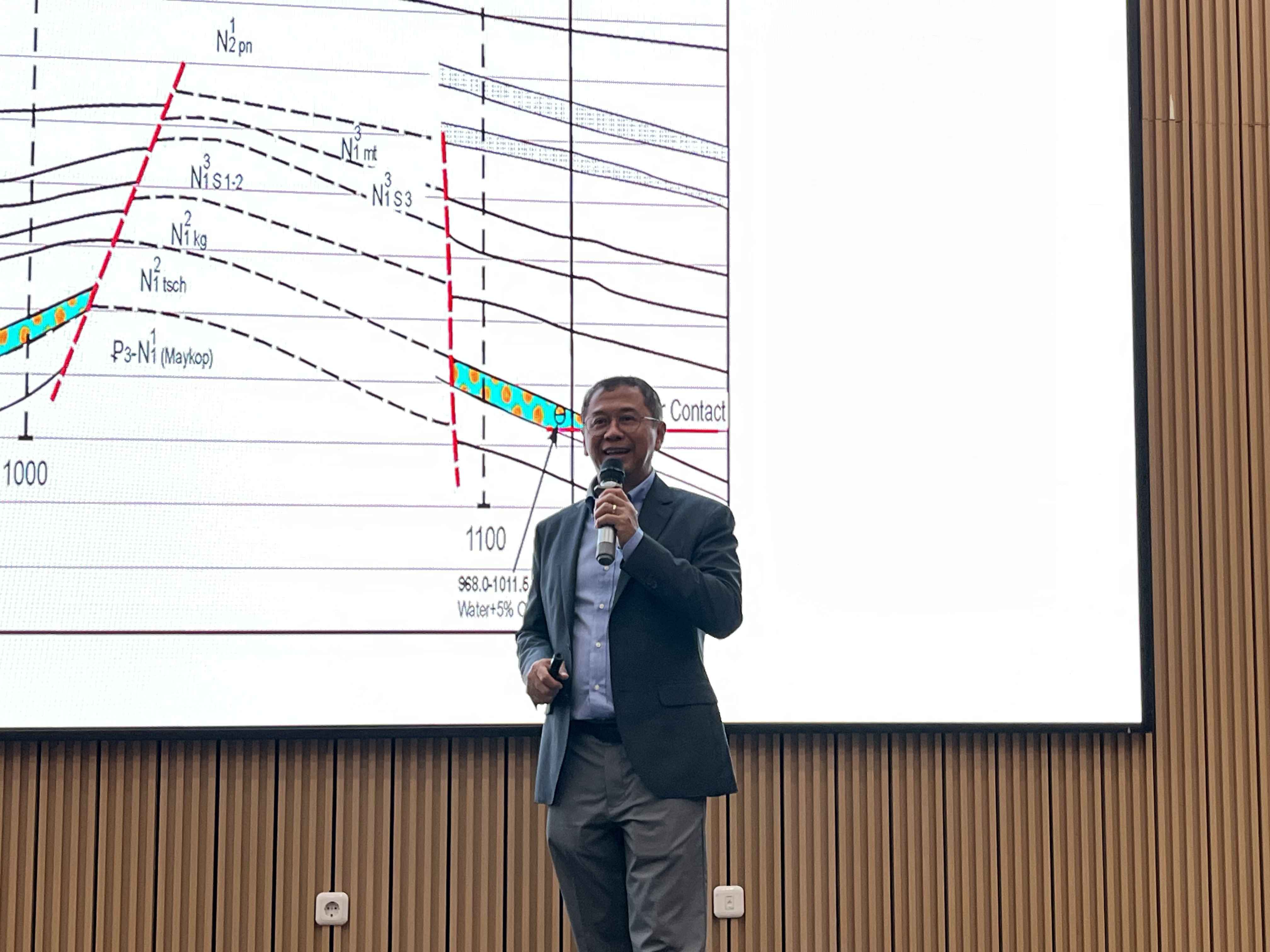
SPE ITS Upstream Series 2025 Explores Future of Drilling Technology in Collaboration with Mubadala Energy
Dec 09, 2025
Similar Article
FEALING: Free Medical Check-Up Event Promotes Health Awareness
In a bid to increase awareness on the importance of health, the Community Outreach Division SPE ITS SC has taken the initiative to organize a medical check-up event called "FEALING (Fun Healing)". The event has successfully conducted in collaboration with the Asian Medical Students' Association (AMSA) Universitas Airlangga. The PIC of the event Jonathan Erland Sihotang explained that the event comes at a time when health awareness is increasingly crucial, especially with the transition from the pandemic era. People overlook the fundamental and essential aspects of health, such as lack of exercise, consuming unhealthy food with high levels of sugar, and barely doing medical check-ups. "Those behaviors will cause an increase in the prevalence of hypertension and any of the health issues among people our age or actually affect people of all ages,” Jonathan explained. Despite the importance of health, many people still underestimate its significance, particularly in developing countries where healthcare can be costly. Therefore, the Community Outreach Division has taken the initiative to provide free medical check-ups for those who cannot afford them. “Conducting this event is also in line with Sustainable Development Goal 3, which aims to ensure healthy lives and promote well-being for all ages,” Jonathan added. According to Jonathan, FEALING which took place on Sunday, 13th November 2022 from morning to afternoon at Taman Harmoni Keputih in Surabaya, provided a range of medical check-ups including blood sugar, tension, and uric acid tests. "We hope to accommodate those who are underprivileged, to do medical checkups for free and increase the awareness of local residents about the importance of health." Jonathan said. The health check-up event at Taman Harmony was a great success, with a majority of elderly participants from the surrounding area. Within just four hours, the target of 100 participants was achieved due to the overwhelming response, with most of them coming in groups. "I am so grateful for this free health check-up. It's an opportunity for us to monitor our health without spending any money," said one of the participants, who was delighted with the initiative.The Community Outreach Division and AMSA-Unair believe that events like FEALING will increase health awareness in the local community and ultimately lead to healthier lifestyles. The hope is that the event will inspire more organizations to take similar initiatives in promoting health and well-being in the community. "I am thrilled to see such an enthusiastic response from the community. It shows that people are taking their health seriously," Jonathan concluded. By: Tyara Novia
PHM Accelerates Gas Production with 20 MMSCFD Boost from New Mahakam Platform
Indonesia's energy landscape received a significant lift as Pertamina Hulu Mahakam (PHM) launched Platform WPN-7, boosting gas production by 20 million standard cubic feet per day (MMSCFD) in the Mahakam Block. This achievement underscores ongoing efforts to secure national gas supplies amid rising demands.Located offshore in East Kalimantan's mature Sisi Nubi field, WPN-7 went operational on March 23, 2026. It features two key wells: NB-701, which began flowing at 9.8 MMSCFD on March 25, and NB-702, achieving 12.5 MMSCFD by March 26. Together, they target a combined initial output of 20 MMSCFD, with PHM actively monitoring to stabilize and optimize performance in line with Q1 2026 objectives.This platform represents the third in the Sisi Nubi Area of Interest (SNB AOI) 1-3-5 project. Predecessors include WPS-4, activated December 4, 2025, and WPS-5 on February 23, 2026. These phased developments build on rigorous technical groundwork, revitalizing output from the longstanding Mahakam Block, a cornerstone of Indonesia's upstream sector.The boost aligns with broader national strategies, enhancing energy resilience. PHM's initiatives complement prior Mahakam projects that added substantial capacities, like up to 36 MMSCFD, supporting SKK Migas targets for oil and gas stability."These new wells play a vital role in ensuring steady gas availability and strengthening our upstream self-sufficiency goals," said PHM General Manager Setyo. As Indonesia navigates energy transitions, such milestones from mature fields like Mahakam remain crucial for economic and supply security into 2026 and beyond.
Written by: Christya
ExxonMobil’s US$15 Billion Bet: Can It Change Indonesia’s Energy Future?
An investment of US$15 billion has been made by ExxonMobil Corporation to establish a petrochemical refinery and carbon capture and storage (CCS) in Indonesia. This massive commitment of over Rp239 trillion aims to promote sustainable energy in the country by using an advanced technology to capture carbon dioxide (CO2) from industrial sources and store it underground. Carole Gall, President Director of ExxonMobil Indonesia, has underlined the corporation’s commitment in supporting environmental sustainability, including in achieving Indonesia's net-zero emission goals.Indonesia’s Minister of Investment and Downstream Industry, Rosan Roeslani, stated that ExxonMobil’s initiative was inspired by British Petroleum’s (BP) recent US$7 billion investment in the Tangguh Ubadari, Carbon Capture Utilization & Storage (CCUS), and Compression—or Tangguh UCC—project in Bintuni Bay, West Papua. This project is scheduled to start in 2028 and will include the development of the Ubadari gas field, the installation of CCUS and exhaust gas recirculation (EGR) at the Vorwata Field, and the improvement of the Tangguh LNG facilities with onshore compressors.While ExxonMobil's investment is twice that of BP's, both efforts share a common goal to cut greenhouse gas emissions and help Indonesia in transitioning to a more sustainable future. By implementing CCUS and EGR technologies, this project represents an important step toward increasing the country’s capacity for clean energy production. As more details of ExxonMobil's plans come to light, all eyes will turn to see how this investment would affect Indonesia's energy future.As the spotlight turns toward the execution of ExxonMobil's plans, this unprecedented investment holds the promise of reshaping Indonesia’s energy landscape. By fostering innovation, reducing environmental impact, and enhancing energy production capacity, ExxonMobil's CCS project could serve as a cornerstone for Indonesia's sustainable energy future. The successful implementation of this initiative will not only reinforce Indonesia's position as a key player in the global energy transition but also inspire other nations to follow suit in prioritizing sustainability and environmental stewardship
Everything You Need to Know About The Rising of Gasoline Prices
Image source : Suara.com/Ema RohimahThe recent hike in the price of fuel oil has left the public infuriated. On the same day when President Joko Widodo and the ministers held a press conference last September, the official fuel price increased by 30 percent. The hike—the first in eight years—raised the Pertalite's price from Rp. 7.650 to Rp. 10.000 per liter, diesel price from Rp. 5.150 to Rp. 6.800, and Pertamax from Rp 12.500 to Rp 14.500. This then begs a question, why did the price of gasoline rise?One thing we should know, anything that impacts crude oil will affect gasoline. The price of crude oil, however, always fluctuates. One of the factors that can influence the recent price of crude oil is the supply and demand of crude oil.The principle of supply and demand is the same as what we’ve learned at school, when demand increases, oil prices rise (or supply decreases), and vice versa. For example, Brent crude oil, a type of crude oil, plummeted to $22.58 a barrel in March 2020, reaching its lowest level since 2002 due to the COVID-19 pandemic. That can happen because a lot of businesses closed, which caused the low demand for oil.Geopolitical events in any of the major oil-producing countries might also result in oil trade wars and affect oil prices. Oil prices can skyrocket as a result of conflict or crisis. This is because traders are concerned that it will limit the oil supply, causing prices to rise. The recent Russia-Ukraine conflict made oil prices top $100 per barrel for the first time since 2014 in February. What a number.In addition to crude oil, outside factors may also contribute to raising the price. Retail prices for fuel oil can be influenced by production costs and government regulations, too. The components of production costs that must be considered are the cost of crude oil, the cost of refining, the cost of distribution and marketing, and the cost of taxes. According to the Finance Ministry, Sri Mulyani, the economic price (crude oil price + production cost combined) for Pertalite is supposed to be Rp. 14.450 per liter while diesel is Rp. 13.950 per liter. Of course, the retail gasoline prices that we pay in SPBU are already subsidized by the government.Difference between subsidized prices at the pump and economic prices in Indonesia. Source: Investor Daily Source: U.S. Energy Information Administration, Gasoline and Diesel Fuel UpdateGovernment policy plays a vital role in ensuring that the price is reasonable for both the people and the country. According to President Joko Widodo, the energy subsidy had tripled this year from its original budget, triggered by rising global prices of oil and gas. So, rather than increasing the number of subsidies, the decision to raise fuel prices appears plausible for the time being. But why isn't the price of gasoline rising in neighboring countries like Malaysia?Well, despite having similarities in many aspects, the production and distribution of energy are structurally quite different due to factors like market size and domestic supply. Indonesia has not recently made significant profits because the domestic market has become the primary market, which is more political and economical to people than profit-driven. This presents a challenge because consumers are used to the days of cheap, plentiful oil, while Indonesia is producing less than it once did. Oil production and consumption in Indonesia Source: BP Statistical Review of World Energy, various yearsPertamina’s limited refinery capacity means that it has become ever more reliant on imports and thus more sensitive to swings in global energy prices. Contrarily, Malaysia has consistently generated profits and has managed to hold gasoline prices steady despite volatility in the world energy markets. It is difficult to compare the two countries since Malaysia has a much smaller domestic market than Indonesia.The rising of fuel prices is a really sensitive issue, any changes will have a significant impact on households and small businesses. Indonesia probably needs to allocate more spending toward human resources investment, like creating more jobs and improving education, in order to be resilient to the swings of global energy. It must do more than just raise the prices to benefit from its demographic transition.References: https://thediplomat.com/2022/09/why-the-price-of-petrol-increased-in-indonesia-but-not-in-malaysia/https://www.thebalancemoney.com/how-are-oil-prices-determined-3305650#:~:text=What%20affects%20the%20price%20of,supply%2C%20and%20expected%20global%20demand.https://www.investopedia.com/articles/investing/072515/top-factors-reports-affect-price-oil.asphttps://www.investopedia.com/articles/economics/08/determining-oil-prices.asp