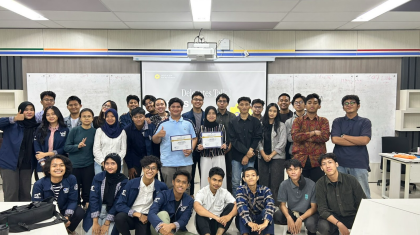
Empowering Future Champions through Delegates Talk 1.0
Jan 22, 2024
Written By: Arya Nugraha Aulia Rahman Yusup
Similar Article
Unlocking Indonesia’s Hidden Energy Treasures: The Future of Oil and Gas Exploration
Indonesia is at a crucial point in its oil and gas journey. On one hand, the country has vast untapped energy resources that could fuel the economy for years to come. On the other, many of its existing oil fields are aging, leading to declining production. In 2023, Indonesia’s oil and gas industry was valued at around IDR 280 trillion, and experts predict it could grow to IDR 1,050 trillion by 2032. However, sustaining this growth will require new discoveries and smarter investments in exploration.Right now, Indonesia produces about 576,000 barrels of oil per day (bpd), and the government hopes to push this number to 600,000 bpd by 2025. However, the challenge is that 70% of Indonesia’s oil wells are mature, meaning their output is slowing down. If new reserves aren’t developed soon, Indonesia will have to rely more on imports, which could drive up costs and impact energy security.The good news? There’s still a massive opportunity waiting to be explored. Out of 128 sedimentary basins across Indonesia, only 20 are actively producing oil and gas. That means 68 basins remain untouched, offering huge potential for new discoveries. If properly explored, these areas could significantly boost Indonesia’s production and reduce dependence on imported oil.To tap into this potential, both domestic and international companies are stepping in with major investments. One of the biggest projects is Eni’s Geng North Project, a IDR 192 trillion gas project expected to start production by 2027. Similarly, BP is expanding its Tangguh LNG facility in West Papua with a IDR 112 trillion investment, incorporating carbon capture technology to make production more efficient and sustainable. Meanwhile, Petronas is increasing its footprint in Indonesia by setting up operations in East Java and exploring other regions. These investments highlight global confidence in Indonesia’s oil and gas potential.The government isn’t standing still either. Under President Prabowo Subianto, several initiatives are in place to attract more foreign investment, reactivate 5,000 idle oil wells, and speed up the permitting process for new projects. If these efforts are successful, Indonesia could see a major boost in oil and gas production, strengthening energy security and ensuring long-term economic stability.
Empowering the Next Generation on Energy Awareness with SPE ITS SC's Energy4me
The Society of Petroleum Engineers (SPE) ITS SC held an educational program called Energy4me for more than 20 science club members at Gloria Christian Junior High School. The program aimed to raise awareness about the importance of energy in life, increase understanding of energy and its implementation, and foster enthusiasm in the oil and gas industry.The PIC of the event Asri Dewayanti said Energy4me is an educational program that educates the public about energy and promotes energy consciousness. This program was developed by the Society of Petroleum Engineers to help students understand the science behind the industry and the career opportunities available. "We believe that energy is the most crucial and hot issue right now. Therefore, to increase the potential of the nation's resources, it is our responsibility as a youth to take the initiative to accommodate the discussion forum for sharing knowledge,” added Asri. The program that was held on March 15th included several experiments. One of the experiments was exploring oil seeps. Oil and gas seeps are natural springs where liquid and gaseous hydrocarbons leak out of the ground. These seeps are fed by natural underground accumulations of oil and natural gas. The activity modeled the formation and process of oil seeps. “The students learned how the density of oil and Earth's materials contribute to the process and any modifications that could be made to the model,” continued Asri.Another experiment was Pump it Up, where the students learned how oil and natural gas are pumped from the earth. There are two methods that can be used: primary recovery and secondary recovery. Primary recovery is when oil comes out due to its own pressure, while secondary recovery is when oil is pumped out by injecting natural gas or water into the formation. “In primary recovery, the students learned how to drill for oil with the help of a chemical reaction between bicarbonate and acetic acid,” explained Asri.The third experiment was Perforated Well Casing. Perforation refers to a hole punched in the casing, or liner, of an oil well to connect it to a reservoir of oil or gas. These holes in the good casing allow oil and gas to flow easily into the wellbore, increasing the production of a reservoir. The students learned about the differences in the production of a perforated and non-perforated well casing. “They also discussed the model limitations and ways to improve the experiment,” added Asri.Furthermore, Asri explained, the final experiment was Water Injection, where the students learned about oil drilling using the secondary recovery method of extracting oil by pushing it up with the help of water. The experiment showed how pumping water into a formation can push oil upwards. It demonstrated that more oil can be extracted when water is pumped in the same system or a different pipeline.Asri Dewayanti also emphasized the importance of energy literacy and the need to educate the public about energy. "Education is an effort to prepare future generations who are better, agile, and skilled. It fits perfectly with the need to develop people who have energy literacy and are interested in the oil and gas industry," said Asri.The event was also a part of SPE ITS SC's actualization of social responsibility with the community around and to achieve SDGs 4 Quality Education and 7 Affordable and Clean Energy. Through this collaboration, SPE ITS SC hopes to contribute to building an energy-conscious and educated society. “It was a great honor that we could collaborate with one of the Junior High schools around us in addressing this matter. We feel such events are crucial to maintaining an energy community for a better future,” ended Asri. By: Tyara Novia Andhin
FEALING: Free Medical Check-Up Event Promotes Health Awareness
In a bid to increase awareness on the importance of health, the Community Outreach Division SPE ITS SC has taken the initiative to organize a medical check-up event called "FEALING (Fun Healing)". The event has successfully conducted in collaboration with the Asian Medical Students' Association (AMSA) Universitas Airlangga. The PIC of the event Jonathan Erland Sihotang explained that the event comes at a time when health awareness is increasingly crucial, especially with the transition from the pandemic era. People overlook the fundamental and essential aspects of health, such as lack of exercise, consuming unhealthy food with high levels of sugar, and barely doing medical check-ups. "Those behaviors will cause an increase in the prevalence of hypertension and any of the health issues among people our age or actually affect people of all ages,” Jonathan explained. Despite the importance of health, many people still underestimate its significance, particularly in developing countries where healthcare can be costly. Therefore, the Community Outreach Division has taken the initiative to provide free medical check-ups for those who cannot afford them. “Conducting this event is also in line with Sustainable Development Goal 3, which aims to ensure healthy lives and promote well-being for all ages,” Jonathan added. According to Jonathan, FEALING which took place on Sunday, 13th November 2022 from morning to afternoon at Taman Harmoni Keputih in Surabaya, provided a range of medical check-ups including blood sugar, tension, and uric acid tests. "We hope to accommodate those who are underprivileged, to do medical checkups for free and increase the awareness of local residents about the importance of health." Jonathan said. The health check-up event at Taman Harmony was a great success, with a majority of elderly participants from the surrounding area. Within just four hours, the target of 100 participants was achieved due to the overwhelming response, with most of them coming in groups. "I am so grateful for this free health check-up. It's an opportunity for us to monitor our health without spending any money," said one of the participants, who was delighted with the initiative.The Community Outreach Division and AMSA-Unair believe that events like FEALING will increase health awareness in the local community and ultimately lead to healthier lifestyles. The hope is that the event will inspire more organizations to take similar initiatives in promoting health and well-being in the community. "I am thrilled to see such an enthusiastic response from the community. It shows that people are taking their health seriously," Jonathan concluded. By: Tyara Novia
Dive into the Midstream & Downstream in the Energy Sector
On Saturday, May 4th, 2024, the Science Course Division of SPE ITS SC organized an event titled "Dive into Midstream & Downstream." The event delved deep into two crucial segments of the energy industry which provide participants with valuable insights into their significance, challenges, and innovations.Mr. Dimas Cameeo Wicaksono, Assistant Project Construction at PT Perusahaan Gas Negara, kickstarted the event by shedding light on midstream activities. These activities play a pivotal role in facilitating the interconnectedness of various aspects of the energy industry. Throughout his session, Mr. Dimas covered the transportation, storage, and distribution of oil and gas, the key components of midstream infrastructure, as well as the challenges during the midstream process. He explained the complex network of pipelines, tankers, and terminals that form the infrastructure for transporting hydrocarbons from extraction sites to refineries and distribution centers. Central to midstream operations are the various components of infrastructure that facilitate the processing and transportation of oil and gas. He provided an overview of crucial facilities such as pipelines, compressor stations, storage tanks, and terminals, as well as the protection and supporting facilities in LNG terminal infrastructure. While midstream activities are essential for ensuring the availability of energy resources, they are not without their challenges. Mr. Dimas also shed light on the various issues encountered during the midstream process, such as vandalism/illegal tapping by third parties. Following Dimas's insightful presentation, Mochammad Helmy Aditya, Process Commissioning Engineer at PT Kilang Pertamina Balikpapan, took the stage to deep dive into the downstream sector. This segment explored the current trends, challenges, and innovations shaping downstream operations. One area of focus lies within the refinery operations, particularly the Fluid Catalytic Cracking (FCC) and Residue Fluid Catalytic Cracking (RFCC) units. These units are pivotal in the conversion of heavy hydrocarbon feedstocks into lighter, higher-value products. Mr. Helmy explained about FCC and RFCC units which are vital components of modern refineries that facilitate the conversion of heavy residual oils and vacuum gas oils into valuable gasoline, diesel, and petrochemical feedstocks. These units employ catalytic cracking processes to break down large hydrocarbon molecules into smaller, more desirable products. He explored the unit integration within FCC-RFCC operations involving complex coordination between various sections, including reaction, separation, treating, and upgrading. Moreover, the quality parameters of feed and product streams in FCC-RFCC operations are critical for ensuring product performance, environmental compliance, and market acceptance. Parameters such as sulfur content, octane number, density, and aromatic content are closely monitored to meet regulatory requirements and customer specifications. For PT Kilang Pertamina Internasional, adherence to stringent quality standards is essential to maintain product integrity and competitiveness in the marketplace.Lastly, Mr. Helmy also highlights the environmental considerations that play a significant role in the operation of FCC-RFCC units, particularly in minimizing emissions, waste generation, and energy consumption. PT Kilang Pertamina Internasional prioritizes environmental stewardship by implementing advanced emission control technologies, optimizing energy efficiency, and promoting sustainable practices throughout its operations.Despite being held online, the event attracted many participants who were eager to expand their knowledge of midstream and downstream operations. Participants enthusiastically engaged with the speakers by actively asking questions and participating in discussions.As the sessions drew to a close, the Research and Information Division conducted a Petroquiz covering the materials and topics presented during the event. The quiz challenged participants' understanding of midstream and downstream concepts which provided an opportunity to reinforce their learning. After an intense competition, Christian Gunawan emerged as the winner who will earn the SPE Knowledgebook as a token of recognition. Written by: Arya Nugraha Aulia Rahman Yusup