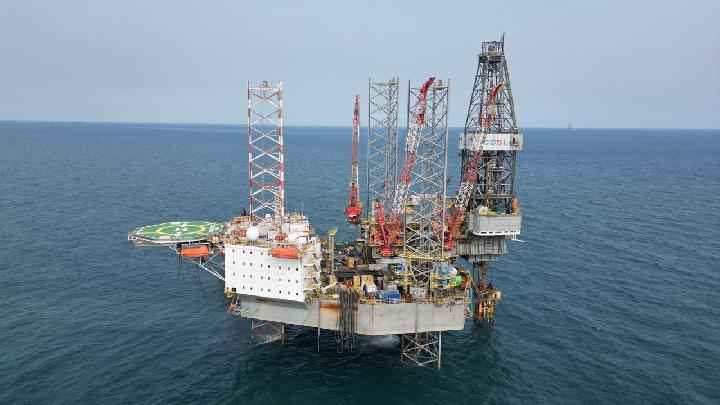
PHM Accelerates Gas Production with 20 MMSCFD Boost from New Mahakam Platform
Apr 08, 2026
Similar Article
SLB and Star Energy Strengthen Partnership to Advance Sekincau Geothermal Project in Indonesia
Indonesia is stepping up its renewable energy efforts through a strategic partnership between global energy technology company SLB and Star Energy Geothermal. The two companies have signed an agreement to support the development of the Sekincau geothermal project in Lampung, marking a deeper phase of collaboration in the country’s geothermal sector.The agreement, signed on Thursday (February 19), expands beyond earlier technology cooperation into a more comprehensive scope that includes field development planning, subsurface evaluation, and integrated drilling services. SLB will play a key role in providing technical expertise, particularly in subsurface mapping, well planning, and drilling operations, all of which are critical in reducing risk during geothermal development.“Advanced technology, deep technical expertise and disciplined operational performance, through integration across the project lifecycle, are essential to scaling geothermal projects,” said Nurzhan Ongaltayev, managing director, Indonesia, SLB. “These agreements and new collaboration opportunities apply SLB’s subsurface consulting expertise and global execution experience to support geothermal development alongside an experienced operator, from project execution in Indonesia to evaluating opportunities overseas.”The Sekincau geothermal project represents more than just another energy development initiative. It reflects a shift in how geothermal projects are approached, with a stronger emphasis on collaboration, technology integration, and risk reduction.If successful, the partnership between SLB and Star Energy could serve as a model for future geothermal developments in Indonesia. By combining technical expertise with operational experience, the project has the potential to accelerate the country’s transition toward a more sustainable and resilient energy system.As demand for clean energy continues to rise, initiatives like Sekincau highlight the importance of turning Indonesia’s vast geothermal resources into tangible and lasting impact.
From the Wellbore to the Neural Network: How the World’s Biggest Oil Companies Are Betting on AI
In 2026, the oil and gas industry’s AI revolution is no longer a forecast, it is an operational reality. The world’s largest energy companies have moved past experimentation, embedding AI into drill floors, control rooms, and thousands of kilometers of pipeline. The results are tangible: fewer equipment failures, lower costs, faster drilling cycles, and tighter emissions control.ExxonMobil was the first in the industry to deploy AI-driven closed-loop drilling automation in a deepwater setting, operating in Guyana where AI systems adjust drilling parameters in real time without human input. In the Permian Basin, machine learning has lifted shale well output by more than 5% and cut data preparation time by roughly 40%.BP has wired over two million sensors across assets in the Gulf of Mexico, the North Sea, and Oman, feeding data into digital twins and its in-house AURA system that simultaneously tracks operational inefficiencies and monitors carbon and methane emissions. The company reports drilling more wells annually as a direct result. Chevron, meanwhile, deploys AI-enabled drones over its Permian operations to detect methane leaks and equipment failures without putting personnel in hazardous zones. Shell applies machine learning to forecast equipment failures before they occur, while Saudi Aramco uses computer vision to monitor thousands of kilometers of pipelines for anomalies.The financial case is well-documented. Boston Consulting Group reports AI has cut operating costs by 15–20% and reduced key cycle times from months to weeks. McKinsey estimates predictive analytics alone lowers maintenance costs by up to 25%. At the field level, AI systems have prevented over 140 hours of unplanned downtime, protecting 1.6% of production uptime figures that translate directly into revenue.The global AI in oil and gas market was valued at USD 7.6 billion in 2025 and is projected to surpass USD 25 billion by 2034, growing at 14.2% annually. Upstream operations account for over half of all AI deployment, driven by the data-intensive nature of exploration and production. North America leads adoption, while Asia-Pacific is forecast as the fastest-growing region through 2031.The companies advancing fastest are not doing so simply to cut costs. They are responding to growing complexity: volatile markets, tightening emissions rules, aging infrastructure, and the sheer volume of real-time data across global assets. Managing all of that with human judgment alone has become impractical. In 2026, AI is not the future of oil and gas. It is the present.
Writer: Akhirian Taka
Why are Oil Prices Important for The Global Economy?
Oil prices have long been a key driver of economic trends around the world. As the primary source of energy for many industries and households, fluctuations in oil prices can have far-reaching effects on both advanced and developing economies. From transportation costs to inflation and industrial production, oil prices impact nearly every sector of the global economy. Given oil's status as a high-demand global commodity, significant price fluctuations can have profound economic consequences. Oil prices are determined by a mix of supply and demand, production costs, and market sentiment. Supply and demand are influenced by the oil futures market, where contracts are made to buy or sell oil at a specific price on a future date. The cost of extraction also affects prices—easily accessible oil is cheaper to produce, while complex methods like deep-sea drilling require costly technology, pushing prices higher. Lastly, market sentiment plays a role, as speculation about future demand can drive up prices when traders buy oil futures contracts in anticipation of future shortages or increased demand.In 2020, the demand for oil plugged during the pandemic, with lockdown causing the price to fall below zero for the first time in history to a sharp downturn in economic activity. Since then, oil prices have surged to nearly $100 per barrel, driven by strong economic recovery post-lockdown. As the economy grows, so does the demand for oil. Oil accounts for approximately 3% of global GDP and is one of the most important commodities worldwide.Source : world economic forumAn increase in oil prices affects not only gasoline cost but also virtually all goods and services. Oil serves as both a feedstock and source of energy and is integral to transportation across industries. When oil prices rise, energy is integral to transportation across industries. When oil prices ries, energy bills increase, and these costs are passed on to consumers through higher prices for goods and services. This often leads to inflation, as the cost of living rises and the purchasing power of consumers declines. For many countries, oil and gas revenues are central to their economic stability. Nations that are major exporters, such as Saudi Arabia and Russia, rely heavily on income from these resources to fund government spending, infrastructure projects, and social programs. When oil prices plummet, these countries face budget deficits, currency devaluations, and economic downturns. On the other hand, oil-importing nations, particularly in the developing world, struggle with rising import costs when prices increase, worsening trade deficits and slowing economic growth. The global dependence on oil and gas keeps national economies vulnerable to market shiftsThe oil and gas industry plays a critical role in global supply chains, especially in sectors like transportation, manufacturing, and agriculture. Rising oil and gas prices can disrupt supply chains by increasing the cost of raw materials, transportation, and energy-intensive production processes. For instance, the shipping industry, which relies on oil-based fuels, faces higher operational costs, which are then passed on to consumers. These disruptions can cause delays in the availability of goods, increase the prices of everyday items, and slow down global trade, impacting economies worldwide.Written by : Fairuz Nabila DaniputriReferences :World Economic Forum, 2022. *Why oil prices matter to the global economy: An expert explains*. World Economic Forum. Available at: [Accessed 16 September 2024].U.S. Energy Information Administration, 2022. *Indonesia – International analysis*. U.S. Energy Information Administration. Available at: [Accessed 16 September 2024].McKinsey & Company, 2020. *Oil and gas after COVID-19: The day of reckoning or a new age of opportunity?* McKinsey & Company. Available at: [Accessed 16 September 2024].
Caught Between a Weak Rupiah and US$100 Crude: How Long Can Indonesia’s Energy Budget Hold?
Why did Indonesia’s monthly energy import bill jump by nearly half when its physical import volume grew by just 15%? Statistics Indonesia (BPS) reported that the country’s oil and natural gas imports reached US$3.77 billion in July 2026, marking a steep 49.91% year-on-year surge compared to the US$2.51 billion recorded in July 2025. The US$1.25 billion year-on-year increase in July’s oil and gas bill contributed significantly to Indonesia’s overall monthly imports, which climbed 27.02% annually to US$26.09 billion, while non-oil and gas imports rose 23.83% to US$22.33 billion. Market analysts and government data point to a combination of elevated global crude prices, a persistently weak Indonesian Rupiah, and a domestic upstream production deficit as the core drivers behind the swelling import bill. Speaking at a press conference in Jakarta, BPS Deputy for Distribution and Service Statistics Ateng Hartono highlighted a sharp divergence between the value and the volume of the country's energy purchases. While the monetary value of oil and gas imports soared by nearly 50%, the physical import volume rose by only 15.44% in July 2026. "The price increase certainly contributed to the rise in oil and gas imports; just compare the values, which are much higher compared to the volumes. Hence, automatically there is a price increase that contributes to the surge," Ateng explained, confirming that global market pricing rather than a sudden spike in domestic consumption was the primary trigger. According to BPS data, the annual jump in July’s energy purchases was fueled by a 51.68% spike in crude oil imports which rose by US$406.3 million alongside a 49.11% increase or US$48.3 million in oil-derived products. Cumulatively, throughout the January - July 2026 period, Indonesia’s oil and gas imports expanded by US$7.39 billion, or 40.24% year-on-year. This seven-month surge was driven by oil-derived product imports totaling US$5.319 billion (up 39.6%) and crude oil imports reaching US$2.075 billion (up 41.81%). Beyond international crude benchmarks which have hovered between US$94 and over US$100 per barrel amid ongoing Middle East geopolitical tensions, Indonesia’s energy bill has been compounded by currency depreciation. With the Rupiah trading under pressure between Rp17,750 and Rp17,926 per US dollar in recent months, state energy company PT Pertamina (Persero) and private importers must spend significantly more in local currency to procure US dollar-denominated oil cargoes. Economists warn that this macroeconomic "triple shock" of high global crude prices, a weak Rupiah, and rising logistics costs is feeding directly into imported inflation. Because energy accounts for roughly 15% of input costs across Indonesia’s manufacturing sector, downstream industries particularly petrochemicals, plastics, and packaging that rely on crude derivatives like naphtha are facing narrower profit margins and rising production expenses. At the same time, heavy corporate demand for US dollars to finance oil and gas imports places recurring pressure on Bank Indonesia’s foreign exchange reserves. At the root of Indonesia’s vulnerability to global oil price swings is a long-standing structural gap between domestic upstream output and national fuel consumption. Since becoming a net oil importer in 2003, Indonesia has struggled to reverse the natural decline of its aging oil fields, while domestic fuel demand has grown to approximately 1.6 million barrels per day (bpd). Data from the Ministry of Energy and Mineral Resources (ESDM) showed that as of September 8, 2026, national crude oil lifting stood at 571,731 bpd, remaining below the 2026 State Budget (APBN) target of 610,000 bpd. To ease the financial strain of expensive crude imports while keeping domestic refineries running at optimal capacity, the government has moved to diversify its import sources, including preparing a second phase of crude oil imports from Russia. Energy and Mineral Resources Minister Bahlil Lahadalia confirmed that the procurement is being executed through a Government-to-Government (G2G) and Government-to-Business (G2B) framework involving the Testing Center for Oil and Gas (Lemigas) and Pertamina under Presidential Regulation No. 26/2026 and Ministerial Decree No. 224.K/MG.03/MEM.M/2026, following an initial shipment of 770,000 barrels processed at the Balikpapan Refinery in late June. "We are looking for priority scales that can secure our crude oil supplies first, as long as they do not violate regulations and are economically viable," Minister Bahlil said in Jakarta, emphasizing that alternative crude sourcing is aimed at safeguarding national energy resilience. While discounted crude cargoes and state fiscal buffers have so far shielded Indonesian citizens from immediate subsidized fuel price hikes, energy analysts caution that tactical import deals are only a temporary relief. Without accelerated upstream investment, widespread deployment of Enhanced Oil Recovery (EOR) technology, and regulatory certainty through the long-awaited Oil and Gas Bill, Indonesia’s trade balance will remain exposed to every global price rally. As global energy volatility persists, can Indonesia reform its upstream oil sector fast enough before the next import bill shock hits?