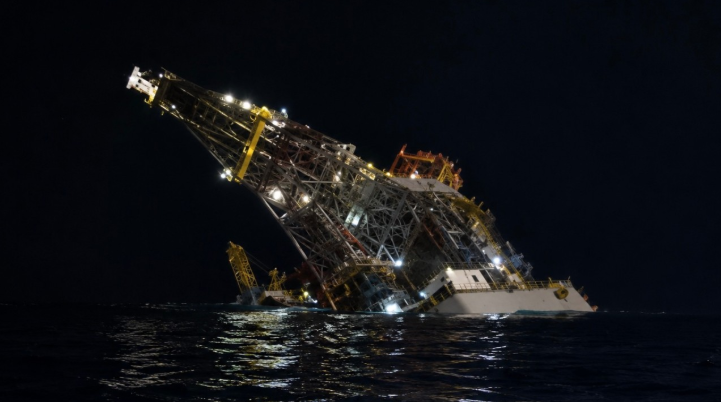
Legs Gave Way, Questions Didn't: Inside the Prospector 5 Sinking That Shook Gabon's Offshore Patch
Nov 12, 2026
Similar Article
Empowering Future Champions through Delegates Talk 1.0
On the 13th of October 2023, the Society of Petroleum Engineers (SPE) Institut Teknologi Sepuluh Nopember (ITS) Student Chapter hosted an inspiring event titled 'Delegates Talk 1.0.' The objective of this program was to provide a platform for successful delegates to share their experiences and tips with members interested in excelling in the competitive world of oil and gas competitions.Asta Raziq, the PIC of the event, explained that the idea behind this was to meet the curiosity of numerous members who were eager to learn how to succeed in competitions. This program aimed to fulfill that desire by arranging face-to-face discussions with speakers who have excelled in oil and gas competitions. Asta Raziq stated, "Our main goal is to shed light on competitions since many members have shown an interest in this field. However, we also want to introduce them to SPE ITS SC on a deeper level. With this delegates' talk, we aim to demystify oil and gas competitions while showcasing fields that may be suitable for our members."The event commenced with presentations by two accomplished speakers, Samuel Zagota and Haya Aqila, who had previously achieved success in various oil and gas competitions, including being the 1st Winner in the Petroleum Business Case Competition at IPFEST ITB 2023. They shared insights into the structure, technicalities, and distinctive characteristics of case studies and business case competitions, providing valuable information to the enthusiastic members.Following these informative presentations, an engaging Q&A session was conducted where several members took the opportunity to ask the speakers about various competitions in the oil & gas field, such as oil rig design and paper competition. Many of the participants were freshmen, new to these competitions and unsure of where to begin. They sought advice and tips from the speakers on how to kick start their journey in these competitions. The exchange of questions and answers fostered a dynamic and engaging atmosphere, making it a valuable part of the event.The event continued with Asta Razqi, the Project Officer for the 2023 SPE ITS SC's Petroleague, presenting the 'Petroleague Roadshow.’ Petroleague is the annual internal competition of SPE ITS SC, this competition is suitable for beginners who want to start their competition journey. The highlight of the event was the Focused Group Discussion (FGD), where both speakers delved into their personal experiences and journeys in the oil & gas competitions. They patiently interacted with the members, addressing their questions and providing insights into their journeys in competitions. The speakers' willingness to discuss the hurdles they had overcome, the strategies they had employed, and the moments of inspiration that had fueled their success not only served as a source of motivation but also demystified the often intimidating world of oil and gas competitions.Through 'Delegates Talk 1.0,' SPE ITS SC not only catered to the interests of its members but also expanded their knowledge about the diversity of competitions within the oil and gas sector. Importantly, it encouraged members and delegates to participate in competitions organized by SPE ITS SC, including the annual Petroleague, and to explore many competitions outside of ITS. “Moreover, there will be a series of introduction series events with various competitions such as Oil Rig Design Competitions, Business Case Competition, Paper & Poster Competition, and Case Study Competitions with hope that members will be able to understand more about the competition and be able to take part in events that will be held in the future.” Asta concludedWritten By: Arya Nugraha Aulia Rahman Yusup
Why are Oil Prices Important for The Global Economy?
Oil prices have long been a key driver of economic trends around the world. As the primary source of energy for many industries and households, fluctuations in oil prices can have far-reaching effects on both advanced and developing economies. From transportation costs to inflation and industrial production, oil prices impact nearly every sector of the global economy. Given oil's status as a high-demand global commodity, significant price fluctuations can have profound economic consequences. Oil prices are determined by a mix of supply and demand, production costs, and market sentiment. Supply and demand are influenced by the oil futures market, where contracts are made to buy or sell oil at a specific price on a future date. The cost of extraction also affects prices—easily accessible oil is cheaper to produce, while complex methods like deep-sea drilling require costly technology, pushing prices higher. Lastly, market sentiment plays a role, as speculation about future demand can drive up prices when traders buy oil futures contracts in anticipation of future shortages or increased demand.In 2020, the demand for oil plugged during the pandemic, with lockdown causing the price to fall below zero for the first time in history to a sharp downturn in economic activity. Since then, oil prices have surged to nearly $100 per barrel, driven by strong economic recovery post-lockdown. As the economy grows, so does the demand for oil. Oil accounts for approximately 3% of global GDP and is one of the most important commodities worldwide.Source : world economic forumAn increase in oil prices affects not only gasoline cost but also virtually all goods and services. Oil serves as both a feedstock and source of energy and is integral to transportation across industries. When oil prices rise, energy is integral to transportation across industries. When oil prices ries, energy bills increase, and these costs are passed on to consumers through higher prices for goods and services. This often leads to inflation, as the cost of living rises and the purchasing power of consumers declines. For many countries, oil and gas revenues are central to their economic stability. Nations that are major exporters, such as Saudi Arabia and Russia, rely heavily on income from these resources to fund government spending, infrastructure projects, and social programs. When oil prices plummet, these countries face budget deficits, currency devaluations, and economic downturns. On the other hand, oil-importing nations, particularly in the developing world, struggle with rising import costs when prices increase, worsening trade deficits and slowing economic growth. The global dependence on oil and gas keeps national economies vulnerable to market shiftsThe oil and gas industry plays a critical role in global supply chains, especially in sectors like transportation, manufacturing, and agriculture. Rising oil and gas prices can disrupt supply chains by increasing the cost of raw materials, transportation, and energy-intensive production processes. For instance, the shipping industry, which relies on oil-based fuels, faces higher operational costs, which are then passed on to consumers. These disruptions can cause delays in the availability of goods, increase the prices of everyday items, and slow down global trade, impacting economies worldwide.Written by : Fairuz Nabila DaniputriReferences :World Economic Forum, 2022. *Why oil prices matter to the global economy: An expert explains*. World Economic Forum. Available at: [Accessed 16 September 2024].U.S. Energy Information Administration, 2022. *Indonesia – International analysis*. U.S. Energy Information Administration. Available at: [Accessed 16 September 2024].McKinsey & Company, 2020. *Oil and gas after COVID-19: The day of reckoning or a new age of opportunity?* McKinsey & Company. Available at: [Accessed 16 September 2024].
Digitalization in Oil and Gas: How AI and Automation Are Transforming the Industry
Artificial Intelligence (AI), as the most important general-purpose technology of today, is rapidly entering industries, creating significant potential for innovations and growth. Instead of relying on traditional and human-centered business processes, many companies are beginning to adopt AI as their solution. Therefore, the oil and gas industry is also undergoing a major transformation, integrating AI-driven technologies to optimize operations, enhance decision-making, and improve safety. The primary goal of AI adoption in this sector is to improve efficiency, which means accelerating processes, reducing operational risks, and minimizing costs. AI can process vast amounts of data faster and more accurately than humans, leading to better resource management and production optimization.The first applications of AI in the oil and gas industry were considered in the 1970s, primarily in data analysis and reservoir modeling. Early AI-driven systems helped geologists interpret seismic data, identifying potential drilling sites with higher accuracy. Over time, advancements in machine learning and automation have enabled more sophisticated applications, from predictive maintenance to real-time monitoring of assets. The petroleum industry is typically divided into three main segments: upstream, midstream, and downstream : Upstream – Focuses on exploration and production of crude oil and natural gas. AI enhances reservoir modeling, seismic data analysis, and drilling efficiency, reducing costs and improving accuracy.Midstream – Involves transportation and storage of crude oil and natural gas. AI optimizes pipeline monitoring, predictive maintenance, and logistics, ensuring safe and efficient operations.Downstream – Covers refining, processing, and distribution of petroleum products. AI improves refinery operations, quality control, demand forecasting, and supply chain management, increasing efficiency and reducing waste.While AI adoption offers numerous advantages, it also presents challenges. High implementation costs, the need for skilled professionals, and cybersecurity risks are major concerns. Integrating AI into traditional infrastructure requires significant investment and adaptation. However, these challenges can be addressed through strategic investments in AI training programs, stronger cybersecurity frameworks, and phased AI integration to minimize disruption. Despite these hurdles, AI is essential for the future of the oil and gas industry. It enhances efficiency, reduces environmental impact, and ensures safer operations. As technology evolves, AI-driven solutions will continue to drive innovation, making the industry more sustainable, competitive, and adaptable to future energy demands
From Fire to Reform: The Story of Piper Alpha
The Piper Alpha disaster, which occurred in the evening of July 6, 1988, remains the deadliest offshore oil tragedy in history. Located in the North Sea and operated by Occidental Petroleum, Piper Alpha was originally commissioned in 1976 as an oil production platform but later modified to address gas production too. These changes, however, were implemented without adequate redesign or risk analysis, introducing weakness that would eventually be disastrous. That evening, a routine maintenance product escalated into an uncontrollable fire, killing 167 of the 226 individuals on board. Just 61 workers survived the disasters.The tragedy started while performing maintenance on Pump A, where a safety valve was taken out of the pipe and was sealed temporarily using a loose blind flange. Due to failure in the permit-to-work procedure, this important information had not been passed onto the night shift. When Pump B failed during the middle of the night, the crew unknowingly re-started Pump A, which caused a massive gas leak. Shortly after, there was a massive explosion, followed by subsequent explosions and uncontrolled fires. The fire suppression system, which was in manual for diving operations, did not get its activation signal in time.The Cullen Inquiry revealed systematic failures: poor shift communication, faulty platform design, and a safety culture that prioritized production. Gas units were sited perilously close to the control room, and there were few barriers to stop fire spread. Emergency preparedness and equipment maintenance were similarly found to be woefully inadequate.The disaster caused immense loss—167 lives, over £1.7 billion in damages, and a 670-ton oil spill with serious environmental impact. In response, the UK overhauled offshore safety regulations. All 106 recommendations from the Cullen Report were adopted, including a shift to a “goal-setting” safety approach and the introduction of the “Safety Case” system. Requiring companies to provide detailed documentation of hazards, risk management, and mitigation strategies. Regulatory oversight was also transferred to the Health and Safety Executive (HSE) to eliminate conflicts of interest.The Piper Alpha disaster marked a turning point in industrial safety worldwide. It emphasized the paramount importance of effective shift communication, disciplined maintenance of safety equipment, good design, and a safety-first attitude at the workplace. It also demonstrated that it is rarely one error that results in catastrophe, but a sequence of ignored risks and poor decisions.